What is Land Art?
As always it’s a problem of language…artists spanning the genres of installation art, land art, and public art are having a bit of a feud.
I have been active in the realm of site-specific installation art since 2003. Sometimes these works were called Land Art by critics, and other times something else. I have made projects all over the world and I am honored to know and work with many leading Land Art practitioners. I have participated in Land Art symposiums, biennales, and exhibitions for more than 20 years. In airports, trains, and cafes, there has been a dialogue on what it is or isn’t. Sometimes this dialog has gotten quite heated. I find that this debate is peculiar and that it may be clouding the real issue at play. On another note, there may also be a difference of cultural sensibilities within a practice that is simply expanding and evolving.
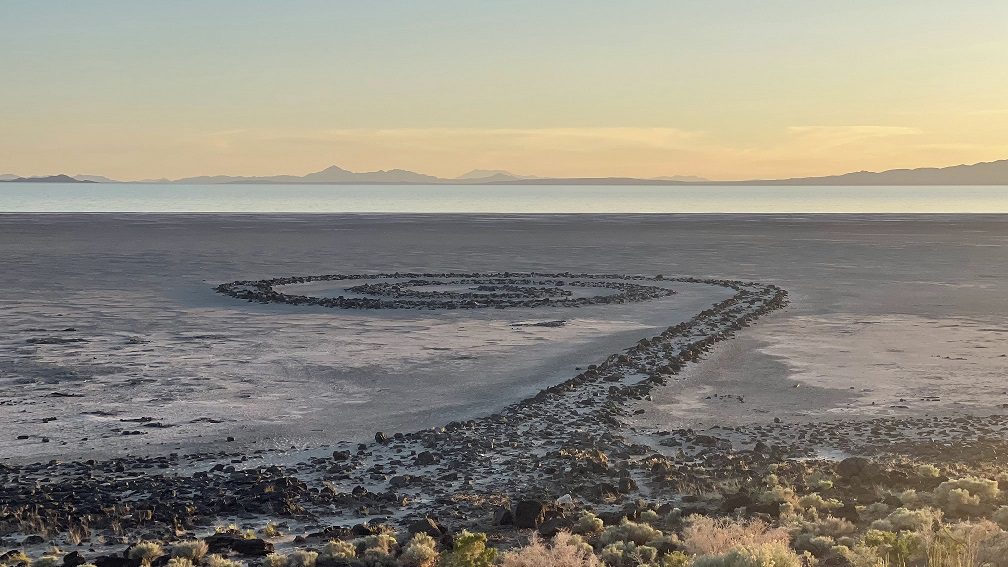
Spiral Jetty, Robert Smithson, Salt Lake City, Utah, photo: John K. Melvin, 2022.
Lets start at the top
In the 1960’s and 70’s artists in the US and UK begin to exit the gallery system and work at the scale of the landscape. These artists made site specific art often at massive scales, often in the wilds of the American southwest, and were the founders of Land Art. Many of these works required aerial documentation as part of this new art practice, further attributing to its shift in scale, or monumentality. Its widely agreed, that these early works were made with materials from the site, were entirely site-specific, often ephemeral, and more often, entirely non-commercial. Land Art took its conceptual lineage primarily from Minimalism and Conceptualism, but also from Cubism, and also the works of Constantin Brancusi and Joseph Beuys.
This ‘standard definition’ of Land Art is widely held by the Tate museum, Sotheby’s, National Galleries of Scotland, and many more sources, listed here at Wikipedia.
In truth, monuments like Stonehenge, Nazca Lines, White Horse, could all be classified as Land Art from a modernist lens. In this article we are trying to clarify what it means today, in a modern sense.
Land Art as a genre is shifting in definition, and has been broadly applied to ‘art in nature’. Its greatest shift is perhaps its application in different continental site situations. Site Situations? Yes, in Europe, we don’t have much open space that hasn’t’ been altered by humans. Even Tuscany is a man made landscape. In the US, and the Americas, there was plenty of space in the 70’s that was wild and untouched.
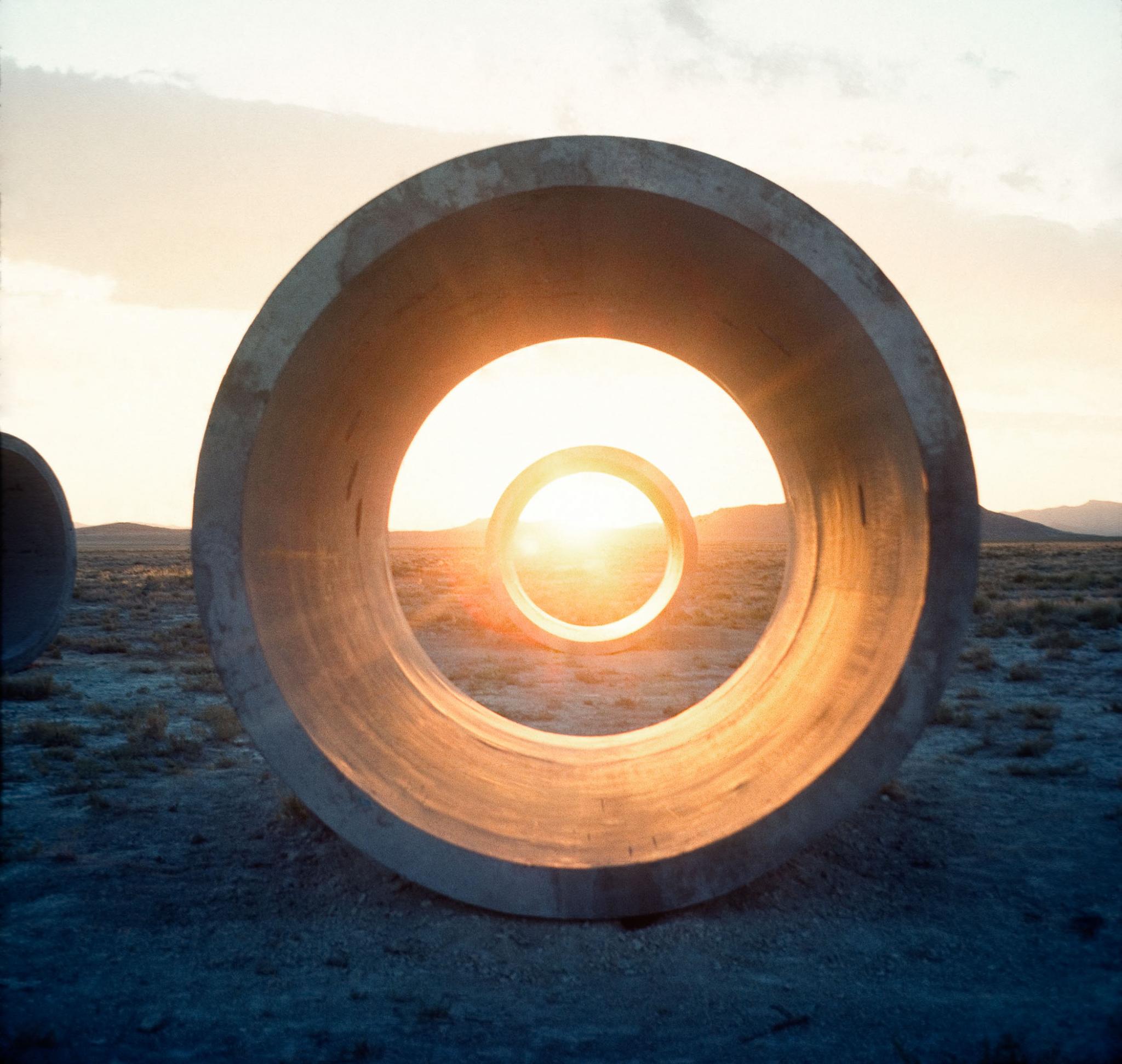
Nancy Holt, Sun Tunnels (1973-76) Great Basin Desert, Utah Concrete, steel, earth Overall dimensions: 9 ft. 2-1/2 in. x 86 ft. x 53 ft. (2.8 x 26.2 x 16.2 m); length on the diagonal: 86 ft. (26.2 m), Image HOLT/SMITHSON Foundation
Land Art in the 20th century
The monumentalism of Land Art practiced by Agnes Denes, Robert Smithson, Michael Heizer, Nancy Holt, was often not quite the same as the Land Art in Europe…Richard Long took walks, Andy Goldsworthy, who came a bit late, worked often much smaller and only with materials on site.
“Wheatfield – A Confrontation: Battery Park Landfill, Downtown Manhattan – With Artist in the field,” 1982. Credit John McGrail, courtesy Leslie Tonkonow Artworks + Projects
This began the first division, or ‘slippage’ in my mind, of Land Art. In Europe, art was installed in natural settings, often with natural materials, but also, often with a chateau in the background, aka, it was installed in a park. We could call this environmental art, particularly if it was made with natural materials, meant to be ephemeral, etc. And obviously artists like Richard Long and Andy Goldsworthy made environmental art, but if Land Art is defined by its monumentality, then no.
monumentality
I take my lead from Richard Serra, and his interview with Hal Foster. Monumentality isn’t about ego. Its about the object-subject relationship between a work of art, and its viewer. When we look at something smaller than ourselves, we can perceive it subjectively; we can ignore it. When that thing is larger than ourselves, it is the one looking at us. We cannot ignore it. That is monumentality.
This shift changes the perception of the viewer; it opens their mind to thinking about larger questions. Expanding monumentality, are the installations of Ann Hamilton, mountains of textile, paper, material, overwhelm the senses and force the viewer to experience the artwork by physically moving, engaging with it. This is true with all monumental work, one can’t simply stand in a corner and pontificate, they actually have to walk around it, step back, repeat, etc.
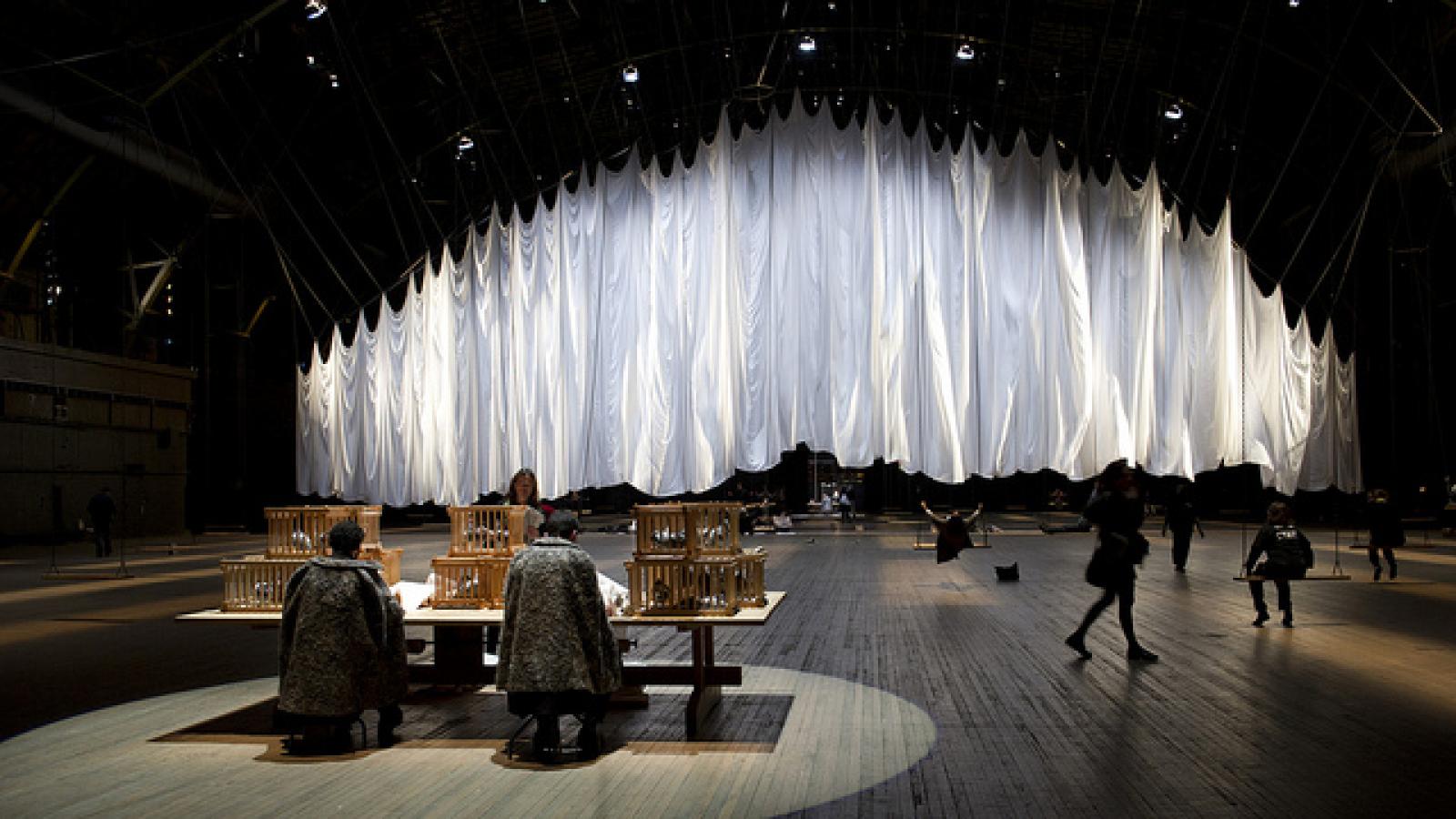
Ann Hamilton’s installation the event of a thread at the Park Avenue Armory in New York City. Photo by flickr user AFS-USA Intercultural Programs
In summary,
Its called Land Art, not space, not earth, but Land. Its site-specific, often ephemeral, often monumental, and often ‘natural’. Forgive me for being pedantic, but Land Art quite simply is about the Land. Even Robert Smithson, who first coined the term Land Art, gave credit to the monumentality and history by declaring the first Land Artists were those who made the Nazca Lines.

Yeni & Nan. Symbolism of crystallization. Araya, 1984 / 2010. Digital color prints fro Ektachrome slides. 13 1/4 x 19 1/2 in. (34 x 50 cm) each one, Ed 5 + 2A/P. Photo: El indio
Blind Spots
Which leads me to another point, art history blind spots. What about the global south?
Land Art elsewhere, quickly became Environmental Art. Outside the US or Europe, artists were dealing firsthand with global expansion, foreign resource extraction, and global industrialization. For these artists, an earth based, or environmentally focused art practice, was quite often activist, political, and highly conceptual. In my reading, artists in the global south were more likely the first Eco-Artists. Artists in South America like Alicia Barney (Colombia), Yeni & Nan (Venezuela), Regina Vater (Brazil), and Juan Downey (Chilean-American), quickly pivoted to documenting habitat destruction, performance work, and land use.
Then again, in Japan, we had the Mono-ha (“School of Things”), founded by Nobuo Sekine and Lee Ufan, produced Phase—Mother Earth in October 1968 — a cylinder of excavated earth set beside the hole it came from, in Kobe. That’s the same year as key American land art moments. But Mono-ha’s concern was phenomenological — the relationship between natural and industrial materials, a reaction against Japan’s rapid industrial development.

Image: ARTFORUM, Nobuo Sekine with his sculpture Phase of Nothingness, 1969/70, at the Japanese Pavilion at the 35th Venice Biennale, 1970. Photo: Yoriko Kushigemachi.
Land Art in the 2000’s
This is when I began to see a lot of shift in the definitions. Some said it had to be only natural materials. Others said the materials had to be on site. Many said it had to be ephemeral. Few swore it could not include concrete or steel. This tightening of language heard in biennales and symposiums, created another problem. Parameters and Permutations. We began to get a lot of Goldsworthy copies. Lots of Patrick Dougherty copies. And a few Richard Longs. What do you expect? Limit the palette, limit the method, and even limit the scope, well, you’ve limited the artist.
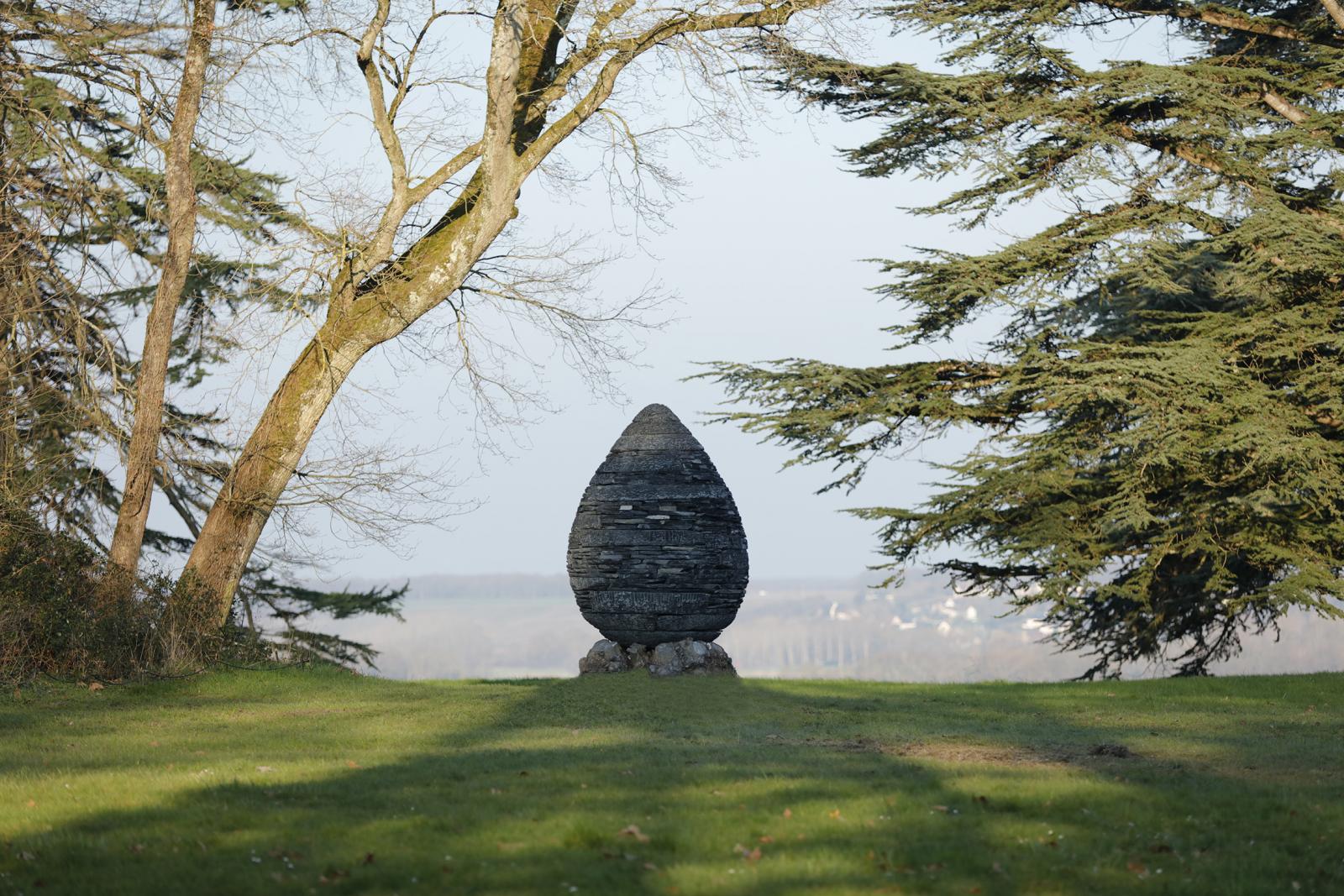
Cairn, installation d’Andy Goldsworthy à Chaumont-sur-Loire – © Éric Sander
In Europe, as I said before, many of these exhibitions happened in parks, regional parks, and parks that had a chateau in the background. So now the situation is even further complicated as we engage in a debate about definitions of Nature, Culture, and Natural. Read Bruno Latour…a note for another article in the future.
Plop Art?
I have seen garishly painted sculpture made in a studio and trucked to the site, and stuck on a platform. Then its called Land Art, because its in the land? Oh, but it’s a dragonfly, yes of course, really? This isn’t Land Art, this is plop art. Plop Art is a derogatory term for Public Art that sprang up in the 70’s in response to numerous acquisitions of permanent art by corporations, institutions, public and private spaces, often the art was without link to the actual site. It wasn’t site specific. It was plopped.
In the Americas, artists like Agnes Denes (Hungarian origin) or Robert Smithson, could talk at length about site specificity, because in many ways, the US was still a young nation. The rapid development in the US 1960’s into the 1980’s was eating up spaces, and many artists felt it necessary to talk about space, place, and the use thereof. Agnes Denes’ installation in what is now battery park, was a rare moment in history, she could actually create work at a large scale.
Today, working at large scales can be difficult, Ai Wei Wei tries, so too does Anne Hamilton, and so too does Olafur Elaison. But Land Art? Even JR’s Pont Neuf homage to Christo & Jean Claude, does it classify as Land Art? No natural materials, confirmed; monumental, yes; about nature, yes, but can we call it Land Art?
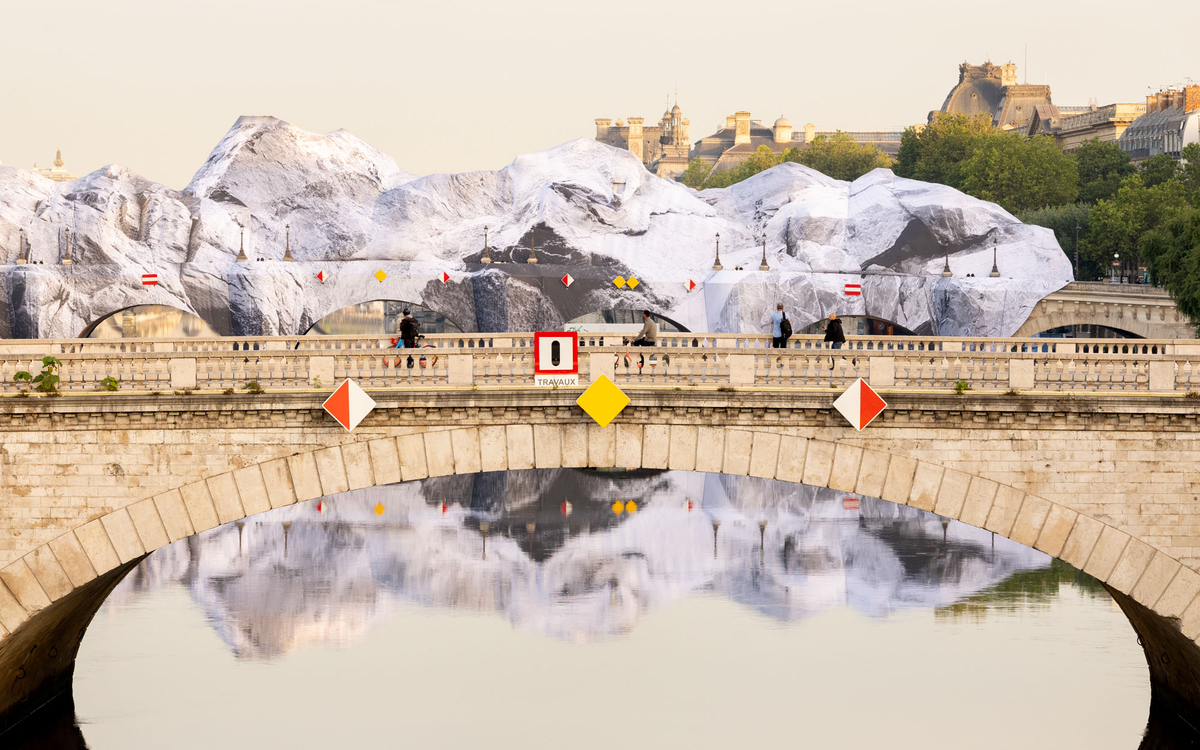
Crédit photo : Jean-Baptiste Gurliat / Ville de Paris
the problem is revealed
Land Art isn’t just big art, its not just site specific art, and one can no longer simply say that art in the landscape is Land Art. Simply put, the landscape has changed. Finally, to limit material choices may no longer be relevant. We cannot be dogmatic about Land Art, a movement that happened 50 years ago, and cannot be repeated in today’s world, because the situation has completely changed.
In fact, we have seen that taking in the global perspective, in Latin America, Japan, and many other countries, Land Art quickly became political, and evolved into Environmental Art, Earth Art, and ultimately Eco-Art.
Today, there is an ecological responsibility asked of contemporary artists making art in the landscape. We need to ask ourselves, why? In fact I would argue anyone who thinks they are making Land Art, is at the very least, making Earth Art and quite possibly, Eco-Art. Wide open spaces are few and far between.
Environmental stewardship and science have taught us the sensitivity of installing work in the wild may not be such a good idea. Look up Christo’s River project, and you’ll see how Robert Smithson would not have been able to make Spiral Jetty today. A response to Christo’s proposal, “Reaction among area residents was intense, with supporters hoping for a tourist boom and opponents fearing that the project would ruin the visual appeal of the landscape and inflict damage on the river ecosystem.”
If we don’t secure something and it falls over and kills somebody, we can be liable. The internet of copies has proliferated and saturated us with images, nothing is original anymore, so if you’re still making Goldsworthy’s or Dougherty’s, why should we care?
No more cowboys. No more cowgirls. Does this mean no more fun?
Of course not. We can have plenty of fun. Quite simply, and to calm the room, Land Art, and its whirlwind of definitions, has evolved.
Ecological Art (Eco-Art)
Eco-Art is the new Land Art.
Eco-Art takes at its core that without the environment we don’t have life. No Planet, no life.
Eco-Art is art making about the ecosystem we live in. When it comes to critical defense of materials or methods, the choice is dependent on the concept, the site, and the application.
Agnes Denes was perhaps the first one, Graham Stevens was another one, so too was Ana Mendieta, and already we see a wide range of materials and methods. Wheatfield to Mylar to performance. Expanding our lens, we see, Nobuo Sekine, Francisco Infante-Arana, Alicia Barney, Yeni & Nan, Regina Vater, Juan Downey, Alan Sonfist, Hans Haacke, and Wolfgang Laib.
Land Art was instrumental in laying a foundation for the definitions of site-specificity, material choices, and the non-commercialization of art. We would not be here without it, but Land Art has evolved.
Eco-Art engages the public in dialog about our ecosystem. What is our connection to the environment, what do we know about it, how do we connect with each other? How are we going to adapt to climate change realities? What will our future look like?
No more dogma
Eco-Art cannot be didactic, but it will be about the good, bad, and the ugly. In the future, like today, we cannot deny climate change, we cannot deny reality. Instead we will have to deal with things as they are. We can’t ignore the problems. We will come up with solutions for a new world. Art, as always, can be a space for dialog, creativity, observation, and innovation. How are we going to build a world that is heading for 12 billion people if we don’t use steel?
To forbid artists from using materials limits their freedom of expression and places them in a dogmatic prison. We should not do this. The only restriction on the artist should be to connect their concept with their form, their material, and their method. If it can be defended, then it should have a place in the conversation.
Art is uniquely Human.
After all, isn’t that what Art is all about, humans talking together and working together?
JKM 2026